


Oral and dental health topics
What is Hydroxyapatite (HAP)? — A Bioactive Material Native to the Human Body
Hydroxyapatite is a naturally occurring mineral and a specific form of calcium apatite. Its precise crystalline chemical formula is $Ca_{10}(PO_4)_6(OH)_2$.
Biologically speaking, HAP is not a foreign substance. It is the primary inorganic component of human bone and dental hard tissues:
- Enamel: Composed of approximately 96-97% Hydroxyapatite.
- Dentin: Composed of approximately 70% Hydroxyapatite.
- Cementum: Composed of approximately 65% Hydroxyapatite.
This "innate" characteristic grants HAP unparalleled Biocompatibility and Bioactivity. In oral care, this means it interacts with dental tissues in the most natural, physiological way possible, promoting repair without rejection or adverse reactions.
HAP in Dentistry: Application Cases
HAP is widely utilized in dentistry, ranging from daily preventive care to advanced restorative procedures.
- Daily Prevention & Health: Toothpaste and Mouthwash
- The most common way for consumers to access HAP. Toothpastes enriched with HAP provide direct remineralization, whitening, and desensitizing benefits to the tooth surface.
Professional Treatment: Root Canal Filling & Bone Defect Repair
- Root Canal Therapy: As early as 1993, clinical studies used HAP powder mixed with iodoform and calcium hydroxide as a filling paste to treat chronic periapical periodontitis, showing excellent results in promoting periapical healing.
- Bone Tissue Repair: As the main component of bone, HAP is used to repair bone defects. Once implanted, the body gradually absorbs the calcium and phosphorus, inducing the growth of new bone tissue.
- Cutting-Edge Restoration: 3D-Printed Bioactive Crowns
- Recent technological advances use HAP-composite resins for high-precision biomimetic crowns. By replicating the highly ordered HAP structure of natural enamel, these 3D-printed crowns offer high mechanical strength, bioactivity, and remineralization capabilities.
International Recognition of HAP
HAP sebagai bahan biologi yang unggul, statusnya telah diakui secara luas di tingkat internasional.
- Safe Ingredient: Regulated globally as a safe raw material for both cosmetics (toothpaste) and pharmaceutical applications.
- Leading Bioactive Material: Renowned in academia and medicine as one of the most promising bioceramics due to its non-toxicity and ability to guide tissue regeneration.
- Scientifically Proven Efficacy: Its benefits in cavity prevention, desensitization, and remineralization are supported by extensive in-vitro and clinical research.
The Role of HAP in Toothpaste
- Remineralization: HAP microparticles deposit into microscopic defects on the tooth surface to replace lost minerals ("demineralization") caused by acid erosion, effectively repairing early-stage caries.
- Sensitivity Relief: Fine HAP particles bond to and plug exposed dentinal tubules (the pathways to nerve pain), creating a protective barrier against thermal and chemical stimuli.
- Cleaning & Whitening: HAP reduces plaque formation through its high adsorptive capacity. By increasing enamel density and filling surface gaps, it restores the tooth's natural luster.
- Gentle Abrasion: Unlike traditional harsh abrasives, HAP has a gentle texture that cleans effectively while minimizing enamel wear, making it ideal for sensitive teeth.
Is HAP Safe?
HAP adalah mineral alami yang sangat aman dan merupakan komponen utama gigi
- - Biocompatible: As a natural component of teeth and bones, it is non-toxic to cells and organs and does not cause immune rejection or allergies.
- Biodegradable: HAP can be gradually dissolved and metabolized by the body. Its metabolites (calcium and phosphorus ions) are essential minerals and completely harmless.
- Broadly Applicable: Its safety and gentleness make HAP toothpaste suitable for everyone, including children, pregnant women, and those with high sensitivity.
How Does HAP Toothpaste Work?
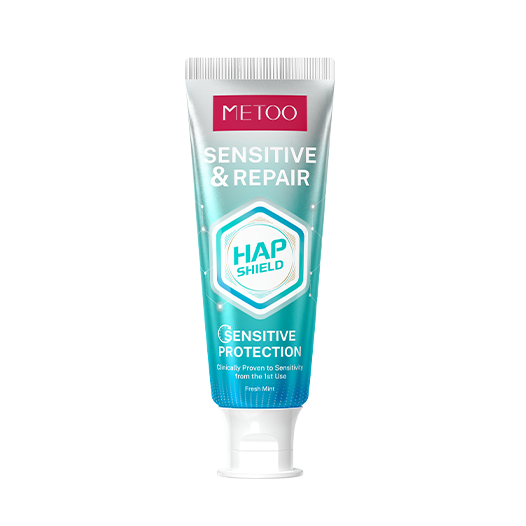
METOO HAP Shield™ Sensitive Care Toothpaste Action Path:
- Rapid Sensitivity Relief
- The synergistic effect of 5% Potassium Nitrate + 5% HAP swiftly alleviates the sharp pain of sensitivity while forming a stable mineral layer to plug tubules and block stimulus transmission.
- Deep Remineralization
- HAP continuously fills invisible microscopic pores and repairs damaged enamel, replenishing essential minerals to make teeth harder, more acid-resistant, and capable of reversing early decay.
- Formation of the HAP Shield™
- Creates an invisible HAP Shield™ on the tooth surface, enhancing strength and hardness to defend against external damage and prevent the recurrence of sensitivity.